For a long time, facility management was seen primarily as a support function that managed buildings, coordinated services and kept costs under control. But that operational role has gradually evolved into a strategic asset. Rising costs, hybrid working, sustainability goals and changing employee expectations call for a broader approach. Facility management now acts as a strategic partner that supports day-to-day operations and actively contributes to an organisation’s goals.
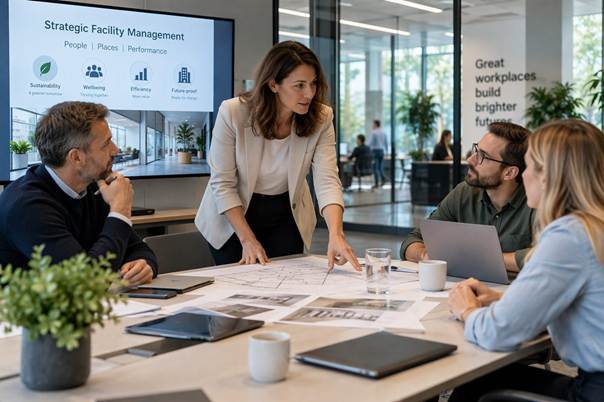
A strategic business partner
Traditionally, facility management focused on organising services such as cleaning, maintenance, catering and building management efficiently. These tasks are essential, but a purely operational approach is no longer enough. Facility management plays an increasingly important role in strategic decisions about premises, workplaces and organisational development, working across departments to do so.
The central question is shifting from ‘How can we reduce our facility costs?’ to ‘How can strategic facility management help improve organisational outcomes?’
The foundations of cost management
Rising staffing, energy and property costs are putting facility budgets under increasing pressure. This is prompting organisations to take a closer look at their spending.
Strategic cost management starts with fundamental choices. How much office space is really needed? Which services are essential? And how can supplier contracts adapt flexibly to changing needs? Looking at cost, quality and flexibility together creates opportunities for lasting improvements. The value a service brings to the organisation matters more than its price.
A working environment that supports people and organisational goals
Hybrid working has changed the role of the workplace. Organisations need to think more carefully about how they use their offices and how best to adapt them to employees’ needs.
Facility management plays an important part in creating a working environment that makes efficient use of space while supporting collaboration, wellbeing and productivity. This calls for close collaboration with HR and IT to align technology, physical space and the way people work.
Data, sustainability and continuity to guide decisions
Understanding facility performance is becoming increasingly important for making informed strategic choices. Data on space usage, energy consumption and maintenance helps organisations optimise costs and meet their sustainability goals.
Flexibility matters too: facility services need to adapt as an organisation grows or shrinks. By anticipating these changes through flexible contracts and careful planning, facility management helps prevent unexpected service costs.
Strategic facility management with an eye on the future
It is therefore more important than ever to see facility management not simply as a support service or cost centre, but as a fully-fledged strategic partner that actively contributes to organisational goals. By involving facility management early in decisions about premises, employees and sustainability, the facilities team can respond to change and help shape the organisation’s future.
Would you like to sit down with a facility management partner who thinks strategically alongside you?
