Multi Masters Group has been a proud partner of River Cleanup for many years. Founded by Thomas De Groote, the organisation is committed to making our rivers plastic-free. To date, this non-profit has removed more than 4 million kilograms of plastic across over 100 countries, with the support of more than 390,000 volunteers. Since 2019, River Cleanup has grown into a global community driven by a clear circular vision and one ambitious goal: to make the world’s rivers plastic-free and keep them that way. In the lead-up to World Cleanup Day, we sat down with founder Thomas De Groote to ask some of our most pressing questions about the journey so far and the road ahead.

“Multi Masters Group was the first organisation to believe in us and place its trust in our mission. Having their support was crucial.” – Thomas de Groote
Thomas, it all started in 2017 when you were challenged to spend 10 minutes picking up litter. Did you ever imagine that this action would grow into the international organisation River Cleanup is today?
Thomas de Groote: “As a child, I was buying things from China to resell in Belgium, so that entrepreneurial spirit was there from an early age. But I wasn’t really concerned with nature; my sister was more the green one of the two of us. My eyes were opened after she challenged me to pick up litter, and I felt there was more potential there. We first organised the RhineCleanUp in 2017, so it started small, but I could already see there was something there. When I noticed that the River Cleanup username was still available on Instagram, I did hesitate for a moment about whether I should go for it. But I took the leap, and the more love I put into it, the bigger the project became.”
Preventive actions
And how have the initiatives and actions evolved over the years?
“In the beginning, I involved as many citizens, schools and companies as possible in cleanup activities. We still organise cleanups today, but we now also work preventively to stop plastic from ending up in rivers in the first place. In countries such as Indonesia, Cameroon and India, we analyse the source of the pollution. Is it caused by inadequate waste management or a lack of awareness among citizens? Based on that, we can set up targeted actions, such as household waste collection or installing waste banks, where people receive money for handing in waste. We want to make sure people have an easy and affordable alternative for disposing of their waste. We have grown in terms of the number of activities and volunteers, while also making a deeper impact by driving structural change.”
How do people view the pollution of ecosystems in 2026? Has that perception changed over the years?
“People still disapprove of the pollution of ecosystems, but surveys show that one in three people occasionally throws waste on the ground. In addition, the COVID-19 pandemic caused another explosion in single-use plastics, as everything was packaged for one-time use. Overconsumption is also becoming an increasingly serious problem. If you order something online today, you want it to arrive tomorrow. And if it isn’t right, you send it back the next day. That obviously has major consequences for our ecosystem, because the more disposable packaging there is, the more of it we will find in nature. We are seeing positive changes in neighbouring countries, such as the introduction of a deposit system for PET bottles and cans in the Netherlands, which has resulted in 80% less litter. In Belgium, the focus is mainly on recycling and sorting single-use plastics, but that does not tackle the problem at its source.”
Influencing policymakers
This year, you launched the bold “Send Dirty Pics” campaign, which allowed people to digitally upload photos of waste they encountered in public places. What was the result?
“For us, the challenge was to raise awareness of litter in people’s surroundings in a light-hearted way, without pointing fingers. People are also bombarded with so much information nowadays that you really have to stand out. There are still many steps involved in convincing people to take part in a campaign like this, but in the end, 16,000 photos were uploaded. And we don’t stop at raising awareness: we are currently using that data to draw up a policy paper. Our analysis shows that cans and plastic bottles are the most commonly found types of waste. So we are using the results of the campaign to influence decision-makers.”
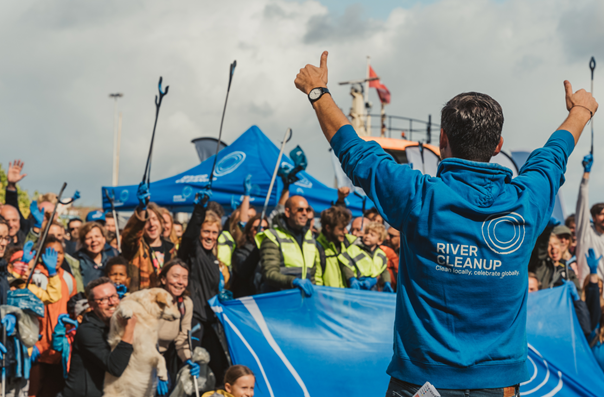
You have personally removed tonnes of plastic from rivers, riverbanks, parks, streets and forests over the years. How do you stay hopeful?
“Every year, 127 billion kilograms of plastic end up in our environment, which is obviously a staggering number. Still, you can feel that everyone is proud of their own local environment. Once you start having conversations with the local communities where we organise waste initiatives, you notice that people genuinely want to take care of their surroundings. Once structural measures are in place and supported by the local community, you can move on to the next location. We cannot simply keep cleaning up forever; you would need an army of millions of people for that.”
Mission 2030
You have built up a large network of partners and investors. How does a partner such as Multi Masters Group help you achieve your targets?
“Multi Masters Group was the first organisation to put its trust in us and believe in our mission in 2019. It was crucial to have the support of Multi Masters Group during that initial phase. At the time, we needed to invest in gloves, litter pickers, waste bags and event materials. In the first two years, we also worked entirely on a voluntary basis. Today, we employ 55 people, including our international teams. You need people to lead all those projects, so even today, you still need partners to make that possible.”
If you had unlimited budget for one innovation project, what kind of project would you launch?
“Those plans are already on the table! With Mission 2030, we want to implement our strategic model across 100 rivers, and by 2050 our goal is to reach 1,000 rivers. We also want to train volunteers structurally so they can provide local support during floods, just as we did in Wallonia.”
Ambassadors to the circular economy story
Let’s talk numbers! World Cleanup Day is once again on the calendar this year on the 19th of September. How many countries will take part this year? How many people? And can you take a guess at how many kilograms of waste you will collect?
“This year, 10,000 River Warriors will take part in 40 countries. We are organising 70 activities, 10 of which are in Belgium. We estimate that each participant will collect 3 kilograms, so we hope to collect around 30,000 kilograms in total.”
Which moment has stayed with you the most so far?
“That first 10-minute challenge in 2017 will always stay with me. That switch from nothing to something: that was when the ball started rolling. More recently, I visited a school in Indonesia. I heard the next generations talking about sustainability and was very impressed. They are true ambassadors of the circular story and set the right example entirely of their own accord. That gives me the energy to keep going.”